14
Bodhisattvas use this Dhāraṇī like a bottomless treasure chest
To decorate and glorify Dharmadhātu, the palace of the Mind.
15
Sit down in your Original Place and see
That everything is as it is, like Buddha of old.
Category: korean buddhism
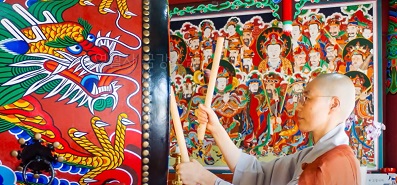
Korean Buddhist Chanting by Bhikkhuni Gumgang
First she does the Thousand Hands and Eyes Sutra. She starts right off with the mantra to purify speech (suri suri mahasuri ….), that is, she does not include the “invocation” at the beginning. Also, she recites the Great Dharani three times, which is very cool. Other than that it is almost exactly the way that Zen Master Seung Sahn taught this chant (there are a few places where her pronunciation is clearly different).
Swim and play in the Dharma King’s Palace (遊戱法王宮)
遊戱法王宮
swim play dharma king palace
遊 yóu, to swim; 戱 xì to play; 法 fǎ Dharma; 王 wáng king; 宮 gōng palace
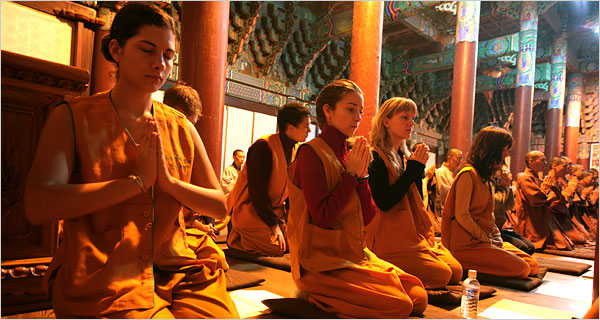
The Ten Merits of Yeom Bul Chanting (高聲念佛十種功德)
First, the merit of waking us from sleep.
Second, the merit of surprising and repelling malicious spirits.
Third, the merit of the sound reaching to the ten directions.
Fourth, the merit of resting the suffering of the three lower paths.
Fifth, the merit of keeping out exterior sounds.
Sixth, the merit of keeping the mind which is chanting from scattering.
Seventh, the merit of (helping us) to make ferocious effort.
Eighth, the merit of making all the buddhas happy.
Ninth, the merit of bringing the experience of samādhi directly to us.
Tenth, the merit of bringing about rebirth in the Pure Land.
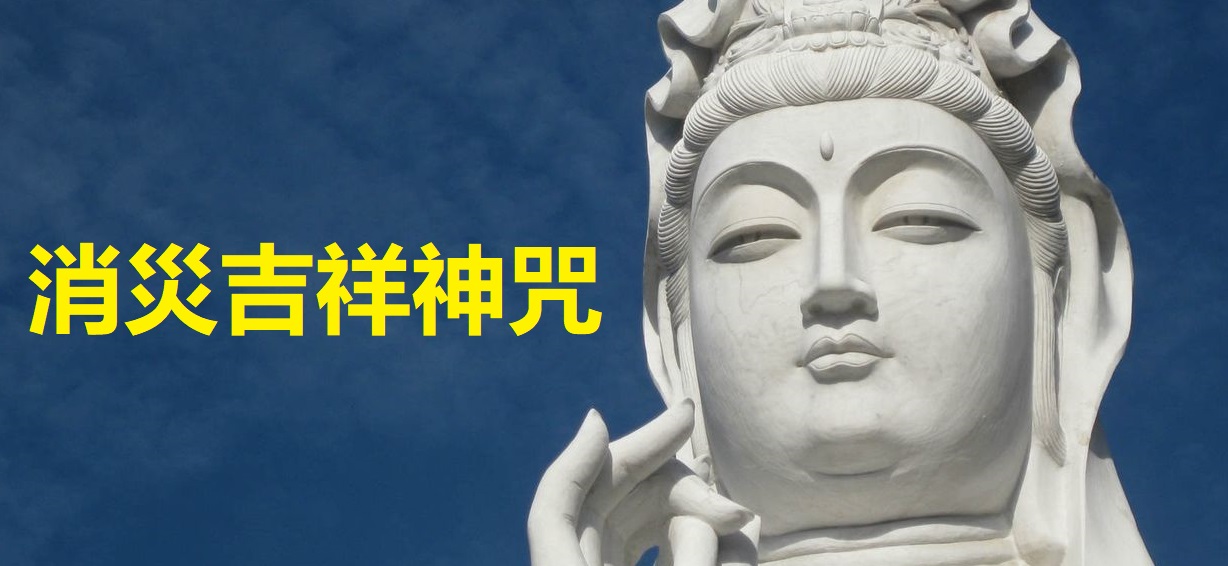
“No matter how busy you are today, please recite the Mantra of Disaster Elimination and Auspiciousness one time!”
今天無論你多忙,請把《消災吉祥神咒》念一遍!
No matter how busy you are today, please recite the Mantra of Disaster Elimination and Auspiciousness one time!
又稱消災咒、消災真言、消災陀羅尼。乃消除諸種災害,成就吉祥事之神咒。
Also known as Disaster Elimination Mantra, Disaster Elimination Mantra, Disaster Elimination Dharani. It is a divine mantra to eliminate all kinds of disasters and achieve auspicious things.
Dharani of the Twelve Buddhas
This Dharani is found in the Twelve Buddhas Sutra (十二佛名神呪校量功德除障滅罪經)
https://read.84000.co/translation/toh511.html
The Twelve Buddhas (十二佛) are also known as the “Twelve Honored Buddhas Who Remove the Karmic Store for Those Who Repent” (懺除業障十二尊佛).
Siddham
Great Compassion Mantra in Siddham: http://www.siddham.org/yuan_english/mantra/emantra_84s_s.pdf Aksharamukha: Script Converter: https://aksharamukha.appspot.com/input/Siddham Proposal to Encode the Siddham Script in ISO/IEC 10646 by Anshuman Pandey: https://escholarship.org/uc/item/1zx6t75q The Siddham script (Chi. 悉曇文字 xītán wénzì; Jap. 悉曇 shittan; Kor. 실담 siltam) is a Brahmi-based script historically used for writing Sanskrit in China, Japan, and Korea. It is also known in […]
Who is reciting the name of the Buddha? 念佛話頭, 念佛是誰
The gong’an exercise of Buddha recitation uses the invocation of Amituofo as a huatou. At the very moment the name is uttered, it must be the focal point in respect to which all doubts and delusions are laid aside. At the same time you ask “Who is this person reciting Amitābha’s name?”
Great Dharani Resources
Here is a collection of resources that will hopefully be helpful to anyone who wants to know more about “The Great Dharani”. Lokesh Chandra • Lokesh Chandra’s book-length study of the Great Dharani: “Thousand-armed Avalokitesvara”: https://www.namsebangdzo.com/Thousand-Armed-Avalokitesvara-p/12549.htm • Lokesh Chandra’s paper: “Origin of Avalokitesvara of Potala”: http://himalaya.socanth.cam.ac.uk/collections/journals/kailash/pdf/kailash_07_01_01.pdf • Another Lokesh Chandra paper: “Origin of Avalokita-svara/Avalokite-svara”: http://www.asiainstitutetorino.it/Indologica/volumes/vol13/vol13_art13_CHANDRA.pdf […]
Kwan Seum Bosal Chanting Part Five: “Misfortune is derived from the mind and is extinguished by the mind”
Introduction Up to this point we have (1) taken refuge in the Triple Gem, (2) called upon the name of Kwan Seum Bosal, (3) recited Kwan Seum Bosal’s mantra for eliminating “karmic obstructions”, and (4) recited the mantra for achieving our “great aspiration” as Bodhisattvas. It’s a hard act to follow! The fifth part of […]