The incense offering mantra (獻香眞言, heon-hyang jin-eon) is found in the Bulja Pillam (Essential Buddhist Compendium, 佛子必覽), first published in 1931. It was intended as a collection of already existing practices, and it’s safe to assume that most of what it contains was already well established. The one novelty that the Bulja Pillam introduced was the inclusion of phonetic Hangul transcription of the Chinese text on each page. That is, while the sutra extracts, worship liturgies, mantras and dharanis were all written in Chinese characters, the pronunciation of each character was also provided in the native Korean script (Hangul).
One of the mantras included in the Bulja Pillam is the incense offering mantra (獻香眞言). As far as I know the original (Hanja and Hangul) text of the Bulja Pillam is not available in electronic format, although a pdf of an English translation (copyright 2017) has been produced by the Jogye Order ( https://jokb.org/bbs/board.php?bo_table=7010&wr_id=43 ). In that translation the mantra title is given in Hanja (獻香眞言), but the mantra itself is only given in romanized transliteration as “Om baara dobiya hum” The transliteration used by Zen Master Seung Sahn when he taught this mantra is slightly different: “Om Ba A Ra To Bi Ya Hum”.
A number of questions can be asked about this mantra:
(1) Where does it come from?
(2) How is the mantra written in Hanja? (And does this matter – and if so, why?)
(3) How is it written in Siddham? (And does this matter – and if so, why?)
(4) Where can we hope to find the “original” Sanskrit form?
(5) What is the relationship between this mantra and the very similar mantra in Tibetan Buddhism: “Om Vajra Duphe Ah Hum”?
Four years after the Bulja Pillam first appeared, a greatly expanded compendium was published, 釋門儀範, Seongmun Wibeom. This title literally translates to “Elucidating the Gate of of Conduct and Rules”, usually translated rather freely as something like “Buddhist Rituals”. Fortunately, the Seongmun Wibeom is available online in digitized form, but only in it’s original, with little or no guidance for anyone who can’t read Korean and Classical Chinese.
Here is the relevant page giving us the Hanja transliteration of the Incense Offering Mantra:
https://kabc.dongguk.edu/content/view?dataId=ABC_NC_04309_0001_T_001
At the above link there is also a scanned image of the original:
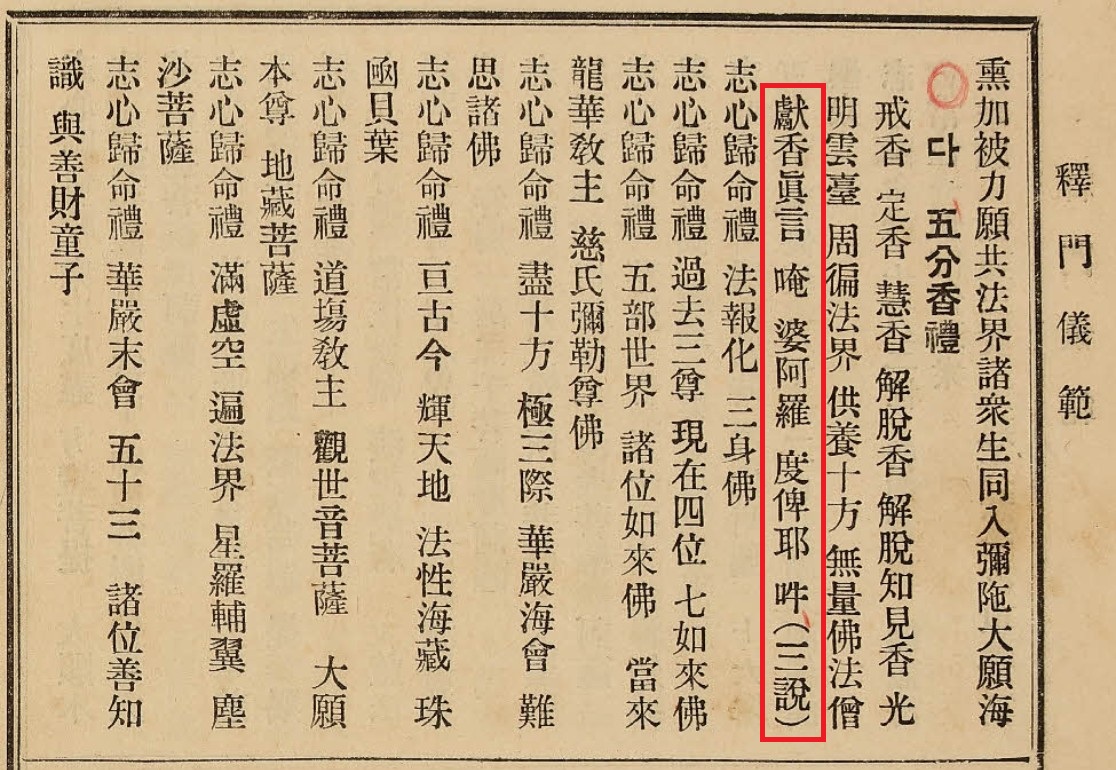
The mantra is outlined in a red box above.
Here is the full Hanja and Hangul:
獻香眞言。唵。婆阿羅。度俾耶。吽。(三說)。
헌향진언。옴。바아라。도비야。훔。(세번)。
If you know a little Hanja and/or Hangul you might be able to make out that the mantra is here part of a larger practice very similar to (but not quite exactly the same as) the Ye Bul ritual that Zen Master Seung Sahn taught to his students under the title “Homage to the Three Jewels”.