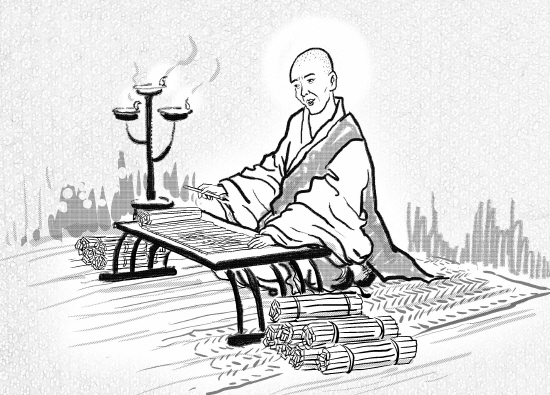
From “The Source of Zen” (禪源) by Guifeng Zongmi (圭峰宗密, 780—841)
https://cbetaonline.dila.edu.tw/zh/T2015_001
N.B.: All translations are from Google Translate (with some minor changes por moi that are not noted): https://www.google.com/search?q=traditional+chinese+to+english
又須識禪心性相方解經論理事。一師有本末馮本印末故。二禪有諸宗互相違阻故。三經如繩墨楷定邪正故。四經有權實須依了義故。
Furthermore, one must understand the nature and characteristics of Zen to comprehend the principles and doctrines of the Sutras and treatises. First, a teacher may have a beginning and an end, thus imprinting the beginning with the end. Second, various schools of Zen may contradict each other. Third, the Sutras are like the carpenter’s ink-line, clearly distinguishing what is erroneous from what is correct. Fourth, expedient and ultimate teachings in scriptures must be relied upon for their definitive meaning.
五量有三種勘契須同故。六疑有多般須具通決故。七法義不同善須辨識故。八心通性相名同義別故。九悟修頓漸言似違反故。
Regarding the Five Measures: three types of verification must align. Regarding the Six Doubts: various forms require comprehensive resolution. Regarding the Seven Doctrines and Meanings: distinctions must be clearly discerned. Regarding the Nine Aspects of Mind: the nature and characteristics differ, and terms may be identical while meanings diverge. Regarding Sudden versus Gradual Realization and Cultivation: verbal expressions may appear contradictory.
十師授方便須識藥病故。初言師有本末者。謂諸宗始祖即是釋迦。經是佛語。禪是佛意。諸佛心口必不相違。諸祖相承根本是佛親付。
The tenth point concerns the teacher’s imparting of skillful means; one must understand the relationship between the medicine and the illness. Regarding the initial statement that the teacher has a lineage (a beginning and an end), it means that the founding ancestor of all these schools is Shakyamuni. The sutras are the Buddha’s words, while Chan represents the Buddha’s intent; the mind and speech of the Buddhas are never at odds. The fundamental basis of the transmission among the patriarchs is the direct entrustment by the Buddha himself.
菩薩造論始末唯弘佛經。況迦葉乃至毱多弘傳皆兼三藏。提多迦已下。因僧[10]諍律教別行。罽賓國已來。因王難經論分化。
The treatises composed by Bodhisattvas were originally intended solely to propagate the Buddhist sutras; however, the propagation efforts of figures ranging from Mahākāśyapa to Upagupta encompassed the entire Tripiṭaka. From Dhītika onwards, the Vinaya teachings began to circulate independently due to internal monastic disputes regarding the precepts; meanwhile, from the time of the Kingdom of Kashmir onwards, the study of sutras and treatises diverged due to royal interference.
中間馬鳴龍樹悉是祖師。造論釋經數千萬偈。觀風化物無定事儀。未有講者毀禪禪者毀講。[*]達摩受法天竺躬至中華。見此方學人多未得法。
Ashvaghosha and Nagarjuna, the patriarchs who lived in the intervening period, composed treatises and commentaries on the sutras comprising tens of millions of verses; they adapted their teaching methods to the times and the dispositions of the people, employing no fixed rituals. Yet, there were those who lectured disparaging Chan, and Chan practitioners who disparaged lecturing. Bodhidharma received the Dharma in India and traveled personally to China, where he observed that many students had not yet attained the true Dharma.
唯以名數為解事相為行。欲令知月不在指法是我心。故但以心傳心不立文字。顯宗破執。故有斯言。非離文字說解脫也。故教授得意之者。即頻讚金剛楞伽云。
It is solely through names and numbers that one interprets phenomena, and through practices that one engages with their characteristics. Yet, the realization that the moon lies not in the finger pointing at it is a matter of one’s own mind. Thus, the teaching is transmitted directly from mind to mind, without reliance on written words. This statement serves to shatter attachments and reveal the true doctrine; it does not mean expounding liberation by discarding words entirely. Therefore, in instructing those who have grasped the essential meaning, the *Diamond Sutra* and the *Lankavatara Sutra* are frequently praised, stating:
此二經是我心要。今時弟子彼此迷源。修心者以經論為別宗。講說者以禪門為別法。聞談因果修證。
These two sutras embody the essential heart of my teaching. Yet, in these times, disciples have lost sight of the source. Those who cultivate the mind treat the sutras and treatises as belonging to a separate school, while those who lecture on the teachings regard the Chan school as a separate path—even when discussing the principles of cause and effect, or the stages of cultivati
便推屬經論之家。不知修證正是禪門之本事。聞說即心即佛。便推屬胸襟之禪。不知心佛正是經論之本意
One might relegate the study of sutras and treatises to scholars, unaware that actual cultivation and realization constitute the very essence of the Zen school. Conversely, upon hearing the teaching that “this very mind is the Buddha,” one might dismiss it as merely a matter of subjective Zen sentiment, failing to realize that the identity of mind and Buddha is the fundamental intent of the sutras and treatises themselves.
前敘有人難云。禪師何得講說。余今以此答也)今若不以權實之經論對配深淺禪宗。焉得以教照心以心解教。二禪有諸宗互相違反者。今集所述殆且百家。
(An objection was previously raised: “How can a Chan master engage in exposition?” I offer this reply:) If we do not correlate the varying depths of the Chan school with the scriptures and treatises—distinguishing between expedient and ultimate teachings—how can we use the teachings to illuminate the mind, or use the mind to comprehend the teachings? Furthermore, there are contradictions among the various Chan schools; the present compilation draws upon the views of nearly a hundred different masters.
宗義別者猶將十室。謂江西荷澤北秀南侁牛頭石頭保唐宣什及稠那天台等。立宗傳法互相乖阻。有以空為本。有以知為源。有云寂默方真。有云行坐皆是。
Regarding the divergence of doctrinal lineages—of which there were some ten schools—these included the Jiangxi, Heze, Northern Xiu, Southern Shen, Niutou, Shitou, Baotang, Xuan-Shi, Chou-Na, and Tiantai traditions. They established their respective doctrines and transmitted their teachings in mutual opposition: some posited Emptiness as the fundamental basis, while others regarded Awareness as the source; some maintained that only silent stillness constituted true reality, whereas others held that both walking and sitting were equally valid.
有云[12]見今朝暮分別為作一切皆妄。有云分別為作一切皆真。有萬行悉存。有兼佛亦泯。有放任其志。有拘束其心。有以經律為所依。有以經律為障道。
Some say that all acts of discrimination and volition performed in the present moment are entirely delusory; others say that they are entirely real. Some uphold the full range of practices; others transcend even the Buddha. Some give free rein to their will; others strictly discipline their minds. Some rely upon the sutras and vinaya; others regard them as obstacles to the Path.
非唯汎語而乃[13]礭言。[*]礭弘其宗[*]礭毀餘類。爭[14]得和會也。問是者即收。非者即揀。何須委曲和會。答或空或有。
These are not merely loose generalizations but definitive assertions[13]. They firmly uphold their own school’s tenets while decisively refuting opposing views[14]; how, then, could a reconciliation be achieved? One might ask: “If one accepts what is correct and rejects what is not, why is there any need for convoluted attempts at reconciliation?” The answer lies in the distinction between emptiness and existence.
或性或相。悉非邪僻。但緣各皆黨己為是。[15]斥彼為非。彼此[*]礭定。故須和會。問既皆非邪。即各任[*]礭定。何必會之。答至道歸一精義無二。
Whether regarding nature or characteristics, none are erroneous or deviant; the conflict arises simply because each side champions its own view as correct while dismissing the other as wrong, with both sides firmly entrenched in their respective positions. Thus, a reconciliation is necessary. Question: If neither view is erroneous and each holds firm to its own stance, why is there a need to reconcile them? Answer: The Ultimate Way converges on a single truth; its profound essence is not twofold.
不應兩存。至道非邊了義不偏。不應單取。故必須會之為一令皆圓妙。問以[16]氷雜火勢不[17]俱全。將矛刺盾功不雙勝。諸宗所執既互相違。一是則有一非。
They should not be maintained as two separate entities. The Ultimate Way is free from extremes and the definitive teaching is impartial; one ought not to adopt merely one side. Therefore, they must be harmonized into a single whole so that all is perfect and wondrous. Question: Mixing ice with fire prevents both from fully manifesting; thrusting a spear against a shield means neither prevails. Since the tenets held by various schools contradict one another, affirming one implies negating the other.
如何會令皆妙。答俱存其法俱遣其病。即皆妙也。謂以法就人即難。以人就法即易。人多隨情互執。執即相違。誠如[18]氷火相和矛盾相敵故難也。法本稱理互通。
How can all approaches be wondrous? The answer lies in both upholding the method and dispelling the associated attachment; therein lies the wonder. To adapt the method to the individual is difficult, whereas adapting the individual to the method is easy. People tend to follow their own inclinations and cling to conflicting views—clinging leads to opposition; it is truly as incompatible as mixing ice and fire, hence the difficulty. The method itself, however, accords with principle and allows for mutual understanding.
通即互順自然。凝流皆水鐶釧皆金故易也。舉要而言。局之則皆非。會之則皆是。若不以佛語各示其意各收其長。統為三宗對於三教。
To understand this is to accord naturally with the way things are: just as flowing water is essentially water and bracelets are essentially gold, the underlying nature remains the same. In short, if viewed in isolation, each perspective appears flawed; yet when integrated, each is valid. Thus, by drawing upon the Buddha’s teachings to elucidate the specific intent and unique strengths of each, we can synthesize them into three schools that correspond to the Three Teachings.
則何以會為一代善巧俱成要妙法門。各忘其情同歸智海[19](唯佛所說即異而同。故約佛經會三為一)三經如繩墨揩定邪正者。繩墨非巧。工巧者必以繩墨為憑。
How, then, could it constitute a profound and skillful Dharma-gate—perfect in every respect—that defines the age? Setting aside their respective attachments, all return to the ocean of wisdom[19] (for what the Buddha taught is distinct yet unified; thus, based on the sutras, the three are reconciled into one). Regarding the three sutras serving as the ink-line that distinguishes the erroneous from the correct: the ink-line itself is not a feat of craftsmanship, yet the skilled artisan must rely upon it.